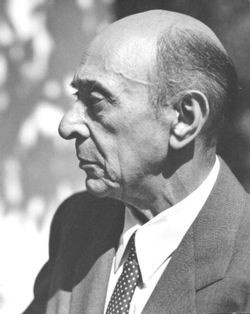
Austrian composer and painter, best known as the (putative) innovator of the twelve-tone technique. Leader of the Second Viennese School.
Starting from the exasperated Wagnerian chromatism of the Tristan with the sextet for strings Verklärte Nacht Op.4 of 1899, the symphonic poem Pelleas und Melisande Op.5 of 1903 and the cantata Die Gurrelieder (1900-1911), he reached the total decomposition and liquidation of the Tonality and Harmony with the Three Pieces for Piano Op.11 of 1909, Five Pieces for Orchestra Op.16 (1909) and the Pierrot Lunaire (1912).
With the Five Pieces for Piano Op.23 and the Serenade Op.24 of 1923 Schoenberg organizes the sounds in a rational way, which he defined:
Method of Composition by means of twelve tones in relation only to each other, called Dodecaphony or serial music . Father in law and private teacher of Felix Greissle, grandfather of Hermann Greissle.
Born 13 September 1874 in Vienna, Austria as Arnold Schönberg, emigrated to the US in 1933 and changed his name to Arnold Schoenberg. He died 13 July 1951 in Los Angeles, California, USA.