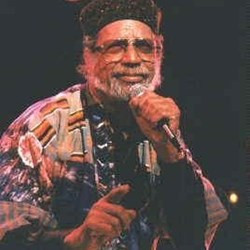
US poet/musician (September 24, 1940, DeLisle, MS - December 3, 2013 Shelton, WA).
Raised in New Orleans, Richard moved to Los Angeles with his father and two brothers after the death of his mother in 1953. He was married by age nineteen and raising a family in Los Angeles when his journey with poetry began. Along with Father Amde Hamilton (a priest of the Ethiopian Orthodox Tewahedo Church) and Otis O'Solomon, Richard Dedeaux formed The Watts Prophets after meeting at the historic Watts Writer's Workshop, a community rebuilding effort born out of the 1965 Watts Riots. Supported by Budd Schulberg, Academy Award winning screenwriter for On The Waterfront, the Watts Writer's Workshop provided an opportunity for locals to express themselves and their culture by encouraging art and literacy. It was out of this creative environment that the Watts Prophets were born. The early works of the three poets were a unique combination of performance poetry, percussive rhythms, and jazz, and were an expression of rage against the racism and poverty that was the day to day reality for most African Americans at that time. This provided the foundation for a unique style that many acknowledge today as the earliest roots of rap. Two albums - Rappin' Black In A White World (1967) and In The Streets Of Watts (1970) as The Black Voices - while nearly impossible to find, continue to be recognized and prized as rap history. Well known rapper DJ Quik, a collaborator and contributor to the Watts Prophets 1997 work When The 90's Came, is one of the many who point to the Watts Prophets as an early source of inspiration. Creating a voice tightly woven with the day to day struggle toward civil rights for African Americans, the Watts Prophets were eventually heard in recordings with popular music legends such as Stevie Wonder and Bob Marley, and have been sampled by artists such as Digable Planets, Coolio and Ice Cube.


APPEARANCES +
Various
Listen, Whitey! The Sounds Of Black Power 1967-1974
2012,  ,
,
, Folk/Spoken Word/Soul/Poetry/Psychedelic/Funk

Various
Stand Up And Be Counted (Soul, Funk And Jazz From A Revolutionary Era Volume 2)
2000, CD,  ,
,
, Funk/Soul

Various
Stolen Moments (Red Hot + Cool)
1994, 2x CD, ,
, Acid Jazz/Conscious/Jazzy Hip-Hop/Downtempo

Quincy Jones
Mellow Madness
1975
Quincy Jones
Mellow Madness
CD,  ,
,
, Jazz-Funk/Soul/Funk
