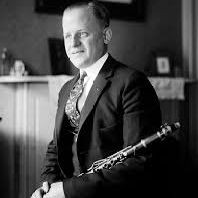
The Virginians Ross Gorman And His Earl Carroll Orchestra Whiteway Jazz Band Gorman’s Novelty Syncopators Ross Gorman And His Virginians Ross Gorman & His Fire-Eaters
Ross Gorman was a clarinettist, saxophonist and bandleader who rose to prominence in Paul Whiteman’s Orchestra and is probably best remembered today for his original playing of the opening clarinet solo in George Gershwin’s Rhapsody In Blue.
Born in Patterson, New Jersey on November 18, 1890 (or 1891, depending on the source of the year of birth), studied music with his father John R. Gorman and appeared with him & his wife Stella in vaudeville as part of the Kiltie Trio.
In 1916, he was part of a five–men group that included Vincent Lopez. In 1919, Gorman joined Harry Yerkes’s band, with whom he recorded for Columbia. In addition to his work with Yerkes’s band, Gorman formed his own Novelty Syncopators (a band that of course comprised him and 3 bandmates of Yerkes’s band plus Eddie Grossbart on drums) and recorded for Columbia on September 27 of 1919 two numbers, one of them was Barking Dog.
For a while, during the first 9 months of 1920, Gorman worked with a variety of groups, among them those of Harry Raderman until he was hired by Paul Whiteman for his orchestra on late October of 1920 as replacement for Gus Mueller. He stayed with Whiteman’s band from late October of 1920 to May of 1925, and during this period, in addition to premiering George Gershwin’s Rhapsody In Blue on 1924, Gorman directed Whiteman’s small jazz subset known as The Virginians.
After leaving Whiteman’s band at the end of May of 1925, Gorman formed his own orchestra, which appeared at Earl Carroll’s Vanities of 1925 revue. Gorman recorded with this band from 1925 to 1927 for [l1866] (including his budget label subsidiary [l108857]), [l112017] & Gennett.
Gorman also worked with many bands, including that of B. A. Rolfe.
In the 1930s he did a lot of radio work and was a staff musician for NBC.
According to Ross’ daughter (and only child) Sheila Gorman, the Gorman family was captivated by airships. On the afternoon of May 6 of 1937, Ross Gorman, his wife Florrie & their daughter Sheila Gorman went to the rooftop of their 43rd Street brownstone to catch the dirigible Hindenburg as it circled Manhattan’s Times Square. Hours later, the once-mammoth marvel was reduced to smoking, twisted wreckage at Lakehurst Naval Air Station, and in the words of Sheila Gorman herself, the Experiment in Modern Motion was as much a failure as Rhapsody in Blue was a success.
Ross Gorman died on February 27, 1953.
ALBA
The Virginians
Mindin' My Bus'ness / I've Got A Cross-Eyed Papa (But He Looks Straight To Me)
1924, Shellac, 10", Victor
The Virginians
She Wouldn't Do What I Asked Her To / Hurdy-Gurdy Blues
1924, Shellac, 10", Victor
The Virginians
Bringin' Home The Bacon / Shine
1924, Shellac, 10", Victor,  ,
,
, Big Band

The Virginians
Whose Izzy Is He / Scissor Grinder Joe
1924, Shellac, 10", Victor,

The Virginians
That Da-Da Strain - I've Got To Cool My Doggies Now / He May Be Your Man
1923, Shellac, 10", Victor,

The Virginians
Whoa, Tillie, Take Your Time! / You Know You Belong To Somebody Else
1923, Shellac, 10", Victor
The Virginians
Farewell Blues = Despedida / Apple Sauce = Compota De Manzana
1923
The Virginians
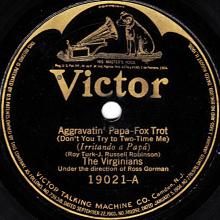
Aggravatin' Papa (Don't You Try To Two-Time Me) / Aunt Hagar's Blues
1923,
The Virginians
I Wish I Could Shimmy Like My Sister Kate / Gee! But I Hate To Go Home Alone
1922, Shellac, 10", Victor
The Virginians
Cuddle Up Blues / My Honey's Lovin' Arms
1922, Shellac, 10", Victor
The Virginians
Who Did You Fool After All? / Rose Of The Rio Grande
1922, Shellac, 10", Victor
The Virginians
Lonesome Mama / Memphis Blues
1922
The Virginians
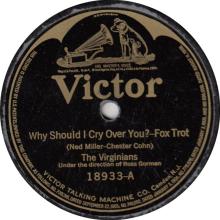
Why Should I Cry Over You? / Blue
1922,
The Virginians
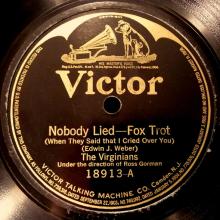
Nobody Lied (When They Said That I Cried Over You) / The Yankee Doodle Blues
1922,
KOMPILACE +
Johnny Hodges Septet
In Concert
2023, CD, Album, SteepleChase,  ,
,
, Swing

Různí
Connoisseur Jazz Cuts (The Comprehensive Collection - Legendary Artists, Essential Music)
2016, 20xCD, Comp, Mono + Box, Membran, Documents,  ,
,
, Bop/Hard Bop/Modal

Eddie Condon, Bud Freeman
Complete Commodore & Decca Eddie Condon & Bud Freeman Sessions
2015, 8xCD, RM + Box, Comp, Ltd, Num, Mosaic Records (2), ,
, Dixieland/Swing

Duke Ellington
The Real... Duke Ellington (The Ultimate Duke Ellington Collection)
2012, 3xCD, Comp, Columbia, Sony Music
Různí
The Ultimate Jazz Archive
2011, 52xCD, Comp + Box, Membran, Motéma, ZOHO, ,
, Dixieland/Swing/Bop/Hard Bop/Post Bop

Duke Ellington And His Famous Orchestra*
The Complete 1932-1940 Brunswick, Columbia And Master Recordings Of Duke Ellington And His Famous Orchestra
2010, 11xCD, Mono, RM + Box, Comp, Ltd, Num, Mosaic Records (2), ,
, Big Band/Swing

Duke Ellington
Carnegie Hall Concerts 1943 / 1947
2010,  ,
,
, Big Band/Swing

The Dutch Jazz Orchestra
Moon Dreams - Rediscovered Music Of Gil Evans & Gerry Mulligan
2008, CD, Album, Challenge Records (3),  ,
,
, Big Band/Cool Jazz/Bop

Modern Jazz Quartet*
Une Anthologie 1952 / 1956
2007, 2xCD, Comp, Nocturne
Různí
Jazz Im New York Der Wilden Zwanziger
2007, 

Duke Ellington And His Orchestra
The Duke Box
2006, 8xCD, Comp + Box, Storyville, ,
, Big Band/Swing

Donald Lambert And His Harlem Piano*
Giant Stride
2005
Claude Thornhill And His Orchestra
1949 ~ '53 Performances
2004, CD, Comp, Mono, RM, Hep Records (3),  ,
,
, Big Band/Swing

The Modern Jazz Quartet
The Complete Modern Jazz Quartet Prestige & Pablo Recordings
2003, ,
, Cool Jazz

Ivie Anderson
It Don't Mean A Thing
2002, CD, Comp, ASV, Living Era, ,
, Swing/Big Band

The Modern Jazz Quartet
Complete 1951-1953 Studio Sessions
2002
Ben Webster
Complete 1943-1951 Small Group Recordings
2001, 3xCD, Comp, Definitive Records (2), 

Duke Ellington
Complete Prestige Carnegie Hall 1943-1944 Concerts
2001, 3xCD, Comp, Definitive Records (2)
Bob Wilber And The Tuxedo Big Band*
Fletcher Henderson's Unrecorded Arrangements For Benny Goodman
2000, CD, Album, Arbors Records
Jan Savitt & His Orchestra*
Shuffle In Style
1999, ,
, Swing

George Gershwin
A Century Of Glory
1998, 2xCD, Comp, Frémeaux & Associés,  ,
,
, Dixieland/Vocal/Swing

Různí
100 Wonderful Years Of George & Ira Gershwin
1998, 4xCD, Comp, Cappella (2), ,
, Interview

Různí
Ragtime To Jazz 2 - 1916-1922
1997, CD, Comp, RM, Timeless Records (3), ,
, Ragtime/Early

Shoeless John Jackson Quartet
A Tribute To Benny Goodman
1997, CD, Album, Progressive Records (2)
Různí
Classic Capitol Jazz Sessions
1997, ,
, Swing/Jump Blues/Ragtime

Jonah Jones
1936-1945
1997, ,
, Swing

Různí
Female Blues Singers Volume 13: R/S (1921-1931)
1996, CD, Comp, Document Records (2), 

George Gershwin
Plays Gershwin
1996, CD, Album, Comp, Magic Talent
Casa Loma Orchestra
Maniac's Ball
1996, CD, Comp, Mono, RE, RM, Hep Records (3), ,
, Big Band

Rosa Henderson
Complete Recorded Works In Chronological Order Volume 1 (1923)
1995, CD, Comp, Document Records (2)
Duke Ellington
Take The 'A' Train
1995,

Duke Ellington
The Duke In Boston 1939-40
1993, CD, Album, Mono, RM, Jazz Unlimited, ,
, Swing/Big Band

Duke Ellington And His Orchestra
1938 Vol. 2
1993, ,
, Swing/Big Band

Benny Goodman & His Orchestra*
Complete Camel Caravan Shows
1992, CD, RM, Jazz Hour Compact Classics
The Ed Polcer All-Stars*
Some Sunny Day
1992, CD, Album, Jazzology, ,
, Swing

George Gershwin
Plays George Gershwin
1991, 2xCD, Comp, Mono, Pearl
Různí
Female Blues Singers Volume R/S (1921-1931)
1991, LP, Comp, Mono, RM, Fantasy By Selmerphone,

Různí
The Complete Commodore Jazz Recordings Volume III
1990, 20xLP + Box, Comp, Mono, Ltd, Mosaic Records (2)
Sidney Bechet
The Blue Note Years
1989, CD, Comp, Mono, Blue Note,  ,
,
, Bop/Dixieland/Swing

Duke Ellington
Braggin' In Brass: The Immortal 1938 Year
1989, ,
, Big Band/Swing

The Modern Jazz Quartet
First Recordings
1988
Red Norvo
Just A Mood The Red Norvo Small Bands
1987, ,
, Swing

Různí
The 1930s - The Singers
1987
Red Nichols And Miff Mole
Great Original Performances - 1925 To 1930
1987,  ,
,
, Dixieland/Swing

Různí
52nd Street Swing The Commodore Years
1986, 4xLP, Comp, Mono, Club, Book-Of-The-Month Records, ,
, Swing/Boogie Woogie

The Modern Jazz Quartet
The Artistry Of The Modern Jazz Quartet
1986
Duke Ellington And His Famous Cotton Club Orchestra*
Reflections In Ellington
1985, LP, Everybodys, ,
, Big Band/Swing

Sidney Bechet
The Complete Blue Note Recordings Of Sidney Bechet
1985,

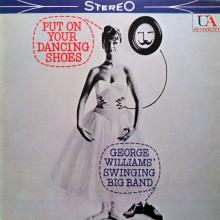
George Williams' Swinging Big Band
Put On Your Dancing Shoes
1984, ,
, Big Band/Swing
Jonah Jones And His Orchestra / Hot Lips Page And His Orchestra
Swing Street Showcase
1983, ,
, Swing

Red Nichols And His Five Pennies
Rhythm Of The Day
1983, ,
, Dixieland/Swing

Rose Murphy
Rose Murphy
1981, LP, Album, Mono, RM, Audiophile (2)
The Tennessee Tooters & The Hottentots
The Recordings 1924-1926
1980,

Duke Ellington
The Duke 1940 "Live" From The Crystal Ballroom In Fargo, ND
1979
Johnny Hodges
At The Sportpalast, Berlin
1978
Duke Ellington And His Orchestra
January 1943
1977, ,
, Big Band/Swing

Acker Bilk
The Best Of Acker Bilk Volume 2
1977,

Red Norvo And His Sextet*
Red's Rose Room - Red's Blue Room
1976
Duke Ellington
The Second Big Band Sound Of Duke Ellington
1975
Různí
The Golden Age Of British Dance Bands
1975, ,
, Big Band/Swing

Duke Ellington And His Orchestra
The Great Paris Concert
1973
Duke Ellington Presents Ivie Anderson
Duke Ellington Presents Ivie Anderson
1973, ,
, Big Band/Swing

The Modern Jazz Quartet
Modern Jazz Quartet
1972, ,
, Post Bop/Cool Jazz

Acker Bilk And The Paramount Jazz Band*
Acker Pie
1972,

Maggie Jones
Volume Two 1925-6
1969, ,
, Swing

Ella Fitzgerald / Duke Ellington
Ella & Duke At The Côte D'Azur
1967, ,
, Swing/Big Band/Latin Jazz

Duke Ellington
Antibes Concert Vol. 1
1967
Russ Morgan And His Orchestra
Music In The Morgan Manner
1967
Modern Jazz Quartet*
Plays For Lovers
1965, ,
, Cool Jazz

Jack Teagarden With Red Nichols' Louisiana Rhythm Kings, Adrian Rollini's Orchestra*, Eddie Lang-Joe Venuti And Their All Star Orchestra, Eddie Condon And His Orchestra, Louis Armstrong And The All Stars*
The Golden Horn Of Jack Teagarden
1964,

Duke Ellington And His Famous Orchestra*
The Ellington Era Volume One: 1927-1940
1963
Jack Teagarden
Big T's Jazz
1962,

The Lawson-Haggart Band*
Dixieland Goes West
1960, 7", EP, Mono, Everest, 

Modern Jazz Quartet*
1 - All The Things You Are
1960, 7", EP, Barclay, Barclay
The Buffalo Bills With Banjo*
Barber Shop! Featuring The Buffalo Bills With Banjo
1959
Sidney Bechet
The Fabulous Sidney Bechet
1958
The Modern Jazz Quartet
MJQ
1958
Eddie Condon And His Orchestra
Jam Session With Eddie Condon
1957
Modern Jazz Quartet* / Milt Jackson Quintet
M J Q
1956, ,
, Cool Jazz

Milt Jackson Modern Jazz Quartet*
Milt Jackson Modern Jazz Quartet
1956,

Lawrence Brown
Slide Trombone Featuring Lawrence Brown
1955
Lenny Herman and The Mightiest Little Band In The Land*
Lenny Herman and "The Mightiest Little Band In The Land"
1955, ,
, Instrumental

Red Norvo And His Sextet*
Rose Room / Roses Of Picardy / Blue Rose / Rose Of Rio Grande
1955
Lenny Herman and The Mightiest Little Band In The Land*
Lenny Herman and "The Mightiest Little Band In The Land"
1955
Claude Thornhill And His Orchestra
Claude Thornhill And His Orchestra Play The Great Jazz Arrangements Of Gerry Mulligan And Ralph Aldrich
1953
Sidney Bechet
Dixie By The Fabulous Sidney Bechet
1953
Chuck Thomas And His Dixieland Band
My Gee Gee From The Fiji Isles / Rose Of The Rio Grande
1949
Bob Grant And His Orchestra
Songs Of Our Times - Song Hits Of 1922
1948
Eddie Condon And His Orchestra
We Called It Music
1947, ,
, Dixieland

Bobby Hackett And His Orchestra
Pennies From Heaven / Rose Of The Rio Grande
1946, ,
, Swing

Glen Gray & The Casa Loma Orchestra
Bugle Call Rag / Rose Of The Rio Grande
1942
Jan Savitt And His Orchestra
Rose Of The Rio Grande / Blues In The Groove
1940, Shellac, 10", Decca
Duke Ellington And His Famous Orchestra*
Rose Of The Rio Grande / A Gypsy Without A Song
1938, Shellac, 10", Brunswick
Frankie Wallace / The Lonesome Cowboy
Stay Away From My Chicken House / Eleven More Months And Ten More Days
1930
Frankie Wallace / The Lone Star Ranger*
Oh! For the Wild And Woolly West / Eleven More Months And Ten More Days
1930
Lone Star Ranger
Eleven More Months And Ten More Days / Pappy's Buried On The Hill
1930, ,
, Country

Ross Gorman & His Virginians*
My Wife's In Europe Today / Pardon The Glove
1927, Shellac, 10", Gennett
The Wolverines
Crazy Quilt / You're Burnin' Me Up (Turnin' Me Down)
1927
Paul Whiteman And His Orchestra
Tell Me More! / Why Do I Love You?
1925, Shellac, 10", Victor,

Ross Gorman & His Earl Carroll Orchestra*
Oh! Boy, What A Girl / You Forgot To Remember
1925, Shellac, 10", Columbia
Herb Wiedoeft's Cinderella Roof Orchestra
Ev'rything Is Hotsy Totsy Now / He's Just A Horn-Tootin' Fool
1925
Paul Whiteman And His Orchestra
Where Is That Old Girl Of Mine?
1924, Shellac, 12", Victor,

"Black Face" Eddie Ross*
Ross' Ju Ju Man / Ross' Florida Cracker
1924, Shellac, 10", Victor
Paul Whiteman And His Orchestra
It Had To Be You / The Hoodoo Man
1924, Shellac, 10", Victor
George Olsen And His Music* / The Virginians
My Papa Doesn't Two-time No Time / Superstitious Blues
1924, Shellac, 10", Victor
Paul Whiteman And His Orchestra / Jean Goldkette And His Orchestra
Pale Moon / Fox Trot Classique
1924, Shellac, 10", Victor, ,
, Big Band

Paul Whiteman And His Orchestra
So This Is Venice! / Learn To Do The Strut
1924, Shellac, 10", Victor
Wendell Hall With The Virginians
Blue Island Blues / Blue Bird Blues
1924, Shellac, 10", Victor
Jane Green (2) With The Virginians
Mamma Loves Papa, Papa Loves Mamma / Mamma Goes Where Papa Goes Or Papa Don't Go Out To-night
1924, Shellac, 10", Victor, ,
, Vocal

International Novelty Orchestra / The Virginians
She Loves Me / Sioux City Sue
1924, Shellac, 10", Victor,

George Price
California Here I Come / I'm Goin' South
1924, Shellac, 10", Victor
Paul Whiteman And His Orchestra
What Do You Do, Sunday, Mary? / Chansonette
1923, Shellac, 10", Victor,

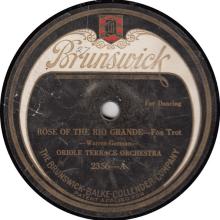
Oriole Terrace Orchestra
Rose Of The Rio Grande / All Muddled Up
1923, Shellac, 10", Brunswick,
Miss Patricola* With The Virginians
Lovin' Sam (The Sheik Of Alabam') / Away Down East In Maine
1923, Shellac, 10", Victor
Garber-Davis Orchestra / The Virginians
Steamboat Sal / Down South Blues
1923, Shellac, 10", Victor
The Benson Orchestra Of Chicago / The Virginians
Wolverine Blues / The House Of David Blues
1923, Shellac, 10", Victor
Waring's Pennsylvanians* / The Virginians
Stack O' Lee Blues / Stavin' Change
1923, Shellac, 10", Victor,

Billy Murray - Ed Smalle
You Said Something When You Said Dixie / Seven Or Eleven (My Dixie Pair O' Dice)
1923, Shellac, 10", Victor
The Great White Way Orchestra / The Virginians
Lost (A Wonderful Girl) / Where The Bamboo Babies Grow
1923, Shellac, 10", Victor, ,
, Instrumental

Belle Baker With The Virginians
I've Got The Yes! We Have No Banana Blues / Jubilee Blues
1923, Shellac, 10", Victor, ,
, Vocal

Miss Patricola* / Billy Murray
Struttin' Jim / Nobody Else Can Love Me Like My Old Tomato Can
1923, Shellac, 10", Victor
Long Beach Society Orchestra / Don Parker's Western Melody Boys
You Know You Belong To Somebody Else / Rose Of The Rio Grande
1923, Shellac, 10", Pathé Actuelle,

Frisco Syncopators
Lost - A Wonderful Girl / Rose Of The Rio Grande
1923, Shellac, 10", Broadway (9),

Vincent Lopez And His Orchestra
Rose Of The Rio Grande / Russian Rose
1923, Shellac, 10", Okeh
Miss Patricola* – Billy Murray / Miss Patricola*
When You And I Were Young Maggie Blues / Come On Home
1923, Shellac, 10", Victor
Georgia Jazz Band
Whoa, Tillie, Take Your Time / Rose Of The Rio Grande
1923, Shellac, 10", Silvertone
Ambrose And His Embassy Club Orchestra*
Dumbell / Jennie / Rose Of The Rio Grande
1923, Shellac, 10", 80 RPM, Columbia
Long Beach Society Orchestra* / Don Parker's Western Melody Boys
You Know You Belong To Somebody Else / Rose Of The Rio Grande
1923
Marion Harris
I Gave You Up Just Before You Threw Me Down / Rose Of The Rio Grande
1923
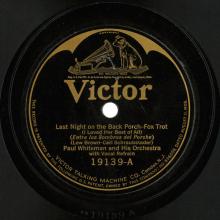
Paul Whiteman And His Orchestra
Last Night On The Back Porch / If I Can't Get The Sweetie I Want
1923,
Paul Whiteman And His Orchestra
Underneath The Mellow Moon / Wonderful One
1923
Paul Whiteman And His Orchestra
Weep No More My Mammy / April Showers
1922, Shellac, 10", Victor,

Paul Whiteman And His Orchestra
Everybody Step / Ka-Lu-A - Blue Danube Blues
1922, Shellac, 10", Victor
Paul Whiteman And His Orchestra / The Virginians
Hot Lips (He's Got Hot Lips When He Plays Jazz) / Send Back My Honeyman
1922, Shellac, 10", Victor,

The Biltmore Society Orchestra / Selvin's Orchestra
Rose Of The Rio Grande / Don't Bring Me Posies
1922, Shellac, 10", Red, Vocalion (2),

Paul Whiteman And His Orchestra / The Great White Way Orchestra
Homesick / All Over Nothing At All
1922,

Paul Whiteman And His Orchestra
Gypsy Blues / When Buddha Smiles
1922
Paul Whiteman And His Orchestra / The Virginians
Chicago / Early In The Morning Blues
1922,

Paul Whiteman And His Orchestra
Rosie / Honolulu Eyes
1921, Shellac, 10", Victor,

Paul Whiteman And His Orchestra
I Never Knew (I Could Love Anybody Like I'm Loving You) / Do You Ever Think Of Me?
1921, Shellac, 10", Victor,

Paul Whiteman And His Orchestra
Bright Eyes / Love Bird
1921, Shellac, 10", Victor
Paul Whiteman And His Orchestra
In A Boat / Sweetheart
1921, Shellac, 10", Victor, ,
, Big Band

Paul Whiteman And His Orchestra
Cherie / My Man
1921, Shellac, 10", Victor,

Paul Whiteman And His Orchestra / All Star Trio And Their Orchestra
You're The Sweetest Girl / Vamping Rose
1921, Shellac, 10", Victor
Paul Whiteman And His Orchestra
Just Snap Your Fingers At Care - Darling / Caresses
1921, Shellac, 12", Victor
Paul Whiteman And His Orchestra / All Star Trio And Their Orchestra
All For You - Happiness / Moonbeams - Pining
1921, Shellac, 12", Victor,

Novelty Five
Laughing Hyena / Barkin' Dog Blues
1920, Shellac, 10", Ver, Aeolian Vocalion
Ted Lewis Jazz Band* / Gorman's Novelty Syncopators
"O" (OH!) / Barkin' Dog
1920
Ted Lewis Jazz Band* / Yerkes Novelty Five
Blues (My Naughty Sweetie Gave Me) / India (Oriental Intermezzo)
1919, 

Henry Busse And His Orchestra
He's Just A Horn Tootin' Fool / Ida Sweet As Apple Cider
Shellac, 10", Decca
Harry Reser
Echoes Of The Roaring Twenties (The Banjo King And His Jazz Pilots)
2xLP, Comp, Odeon, ,
, Ragtime

The Lone Star Ranger* / The Pleasant Family
Eleven More Months And Ten More Days / On The Dummy Line
Shellac, 10", Broadway (9), ,
, Country

Různí
Pioneer Recording Bands, 1917-1920
CD, Comp, Retrieval, ,
, Dixieland/Ragtime

Tommy Tucker And His Orchestra
My Man
LP, Comp, Blue Heaven Records (2), ,
, Big Band

Unknown Artist
Bagpipe/Bagpipe "Melody Of Irish Reels And Gigs
Shellac, 10", Major Records (7)
Russ Morgan And His Orchestra
Music In The Morgan Manner
LP, Comp, Mono, MCA Coral
Jack Teagarden
The Golden Horn Of Jack Teagarden
LP, Comp, RE, MCA Coral, MCA Coral, ,
, Big Band/Dixieland/Swing

Louis Armstrong / Bobby Hackett / Buck Clayton
Tootin' Through The Roof; Volume 2
Jonah Jones And His Orchestra
Rose Of The Rio Grande / Stomping At The Savoy
, Swing

Lawson-Haggart Jazz Band
Blues On The River
The Modern Jazz Quartet
Vendome / Rose Of The Rio Grande
Paul Whiteman & His Orchestra*
Paul Whiteman & His Orchestra Volume 1
, Dixieland/Swing/Big Band

Duke Ellington
Special Moon
Duke Ellington
Ring Dem Bells
Ivie Anderson
I Got It Good And That Ain't Bad!
, Swing/Big Band

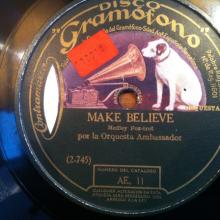
Orquesta Ambassador*
Make Believe / Some Little Bird
, Schlager
The Modern Jazz Quartet
First Recordings!
Různí
The Jazz Modernists 1924-1933
2009, CD, Comp, Retrieval,
